
Experiments
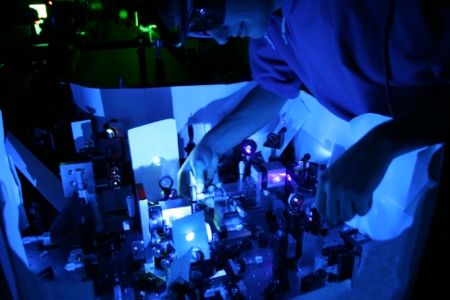
Our research group uses a variety of ultrafast spectroscopy techniques, including quantum control, time-resolved Kerr (or Faraday) rotation, differential reflection/transmission pump probe, transient absorption microscopy, four-wave mixing spectroscopy, actively-stabilized coherent control, micro-photoluminescence, nonlinear dispersion compensation and pulse engineering capabilities.
Our trainees acquire highly-specialized knowledge in quantum technology, semiconductor theory and nonlinear optics. Our group members gain experience with a wide range of cutting-edge optical spectroscopy techniques as well as advanced cryogenics and photodetection, skills that are valuable in a number of rapidly advancing high technology areas, including quantum science and technology, spintronics, photonics, and semiconductor device technology. Our group also encourages technology transfer, including the creation of spin-off companies and collaboration with industry. Our group members have gone on to Research Scientist positions at D-wave Systems, Avalon Holographics, Rayleigh Solar Tech, OZ Optics, M Squared Lasers, the National Research Council of Canada, and the Scientific and Technical Research Council of Turkey. One of our alumni spun off his research in perovskites to form a successful solar cell startup (Rayleigh Solar Tech) and another now applies his knowledge in semiconductor and quantum device technology as an Attorney at Quinn Emanuel specializing in Patent Law. Our trainees have also gone on to research in areas such as Quantum Information, Quantum Algorithms, Ultrafast Materials Science, Quantum Optics, Biomedial Imaging and Condensed Matter Physics, among others.